|
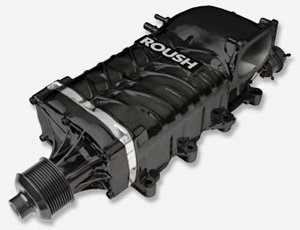
Mustang Performance Parts 3Mustang SuperchargerThese may be the ultimate bolt on Mustang performance parts. A supercharger can turn your ordinary pony car into a fire breathing monster! Unlike a "blower" installation even ten years ago, a new Mustang supercharger has all of the bolts,hoses,belts and hardware to convert a stock motor into a blown beast with little more than basic hand tools.
Mustang Supercharger PrinciplesIt's really a belt driven air compressor,which is run off a crankshaft driven pulley. The amount of compressed air and oxygen that enters the engine is basically a function of the design of the supercharger. That combined with the sizes of the pulleys on the crankshaft and at the body of the compressor determine how fast it turns inside and the amount of pressure it produces. Two Mustang Supercharger Types: The two types of installations we need to care about in our classic and new Mustangs are where either the carburetor or throttle body is pressurized by the pump, such as a Paxton supercharger and a non pressurized set up such as a 6-71 blower,which is common on old skool Mustangs,hot rods and drag racers,where you see the carburetor mounted above the blower. Issues: Clearance is an issue on most cars with a non pressurized system, but it sure looks cool seeing that blower and carb sticking out of the hood of your ol '65 fastback! The newer pressurized systems are more common on newer Mustangs, due to highly packed engine compartments. They also require less modification to linkages and sensors. Click here for comparisons of available popular Mustang Supercharger kits. Mustang TurbochargerOthers, however, feel that the turbocharger, or even twin turbos are the ultimate Mustang performance parts. Mustang Turbocharger Principles: The turbocharger works on a similar principle to the supercharger. This time, however, spent exhaust gasses are routed into the turbine blades of the turbo causing it to spin at times over 100,000 rpm. A second integral chamber on the other side,carries an inlet for intake air,and also has a turbine that spins and acts as a compressor for the incoming air. In both instances,compressing the air laden oxygen,and adding more fuel creates horsepower. Both compressors,now tend to have a small air exchanger called an inter cooler which cools the incoming air. The reason this is necessary, is that compression of the air heats it up which decreases efficiency. Cooling it down first compacts it, so that when heated it remains more compact and produces more power. More Information For comparisons of available popular turbocharger kits and comparisons of the various makes of these popular Mustang performance parts,click here .
Continue to Part 4Click the following link for
mustang performance Part 4.
|